
Designing for Human Flourishing:
Architect Tye Farrow on Health, Dignity, and the Built Environment
Architects Sander Schuur and Jeffrey Murray, FAIA speak with Tye Farrow, partner at Farrow Partners Architects in Toronto, about how enriched environments, multisensory design, and a shift toward mind health can transform everything from offices to affordable housing.
“I think those two lenses of generosity and dignity are fundamental in architecture. We know a lot of buildings that make your experience much easier, and some of those are literal affordances and some of them are metaphorical - it lifts my spirit and it's not literally lifting me, but it is psychologically.”
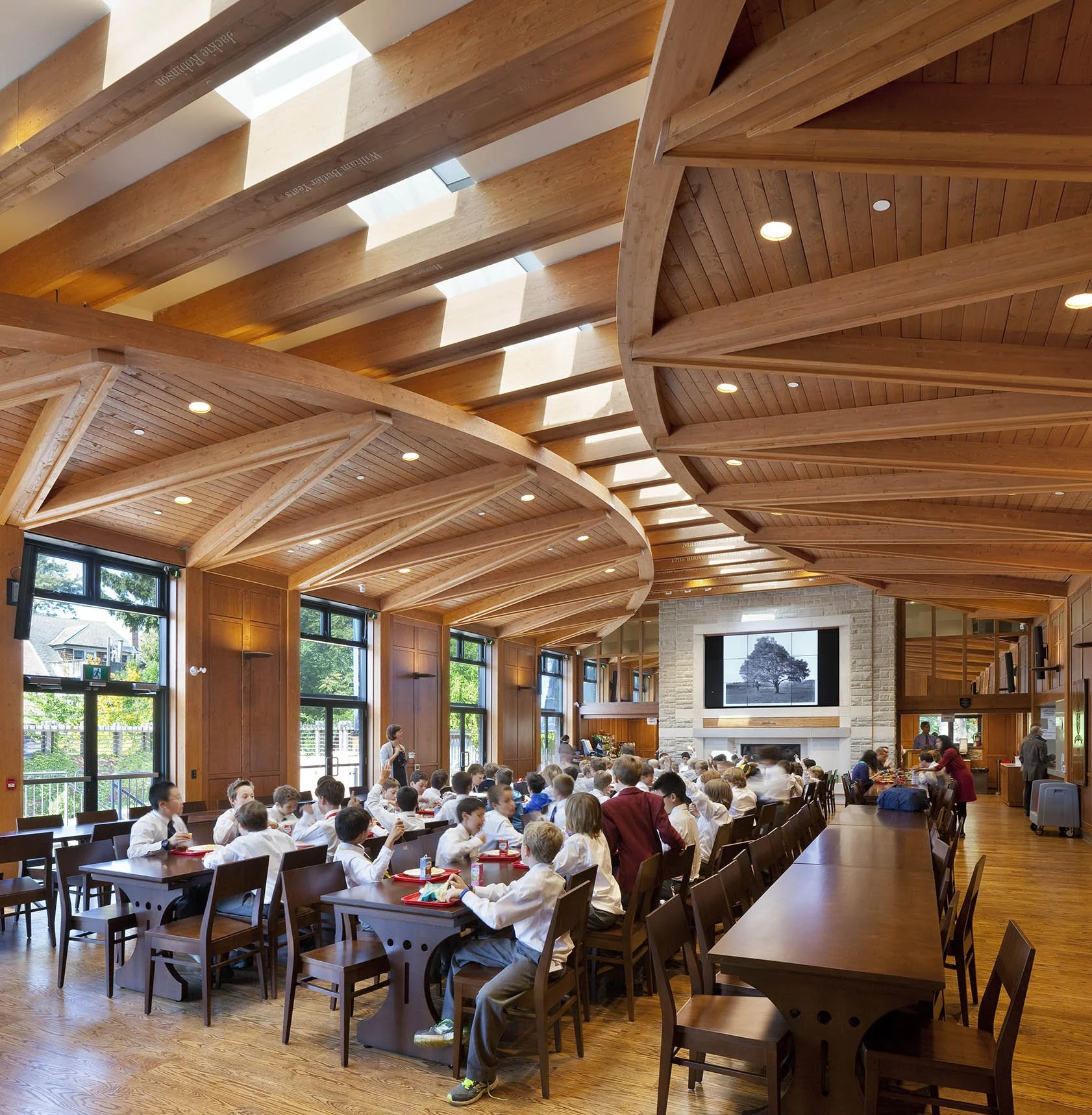
Royal St. George’s College, Toronto, Canada, Farrow Partners
by Tom Arban
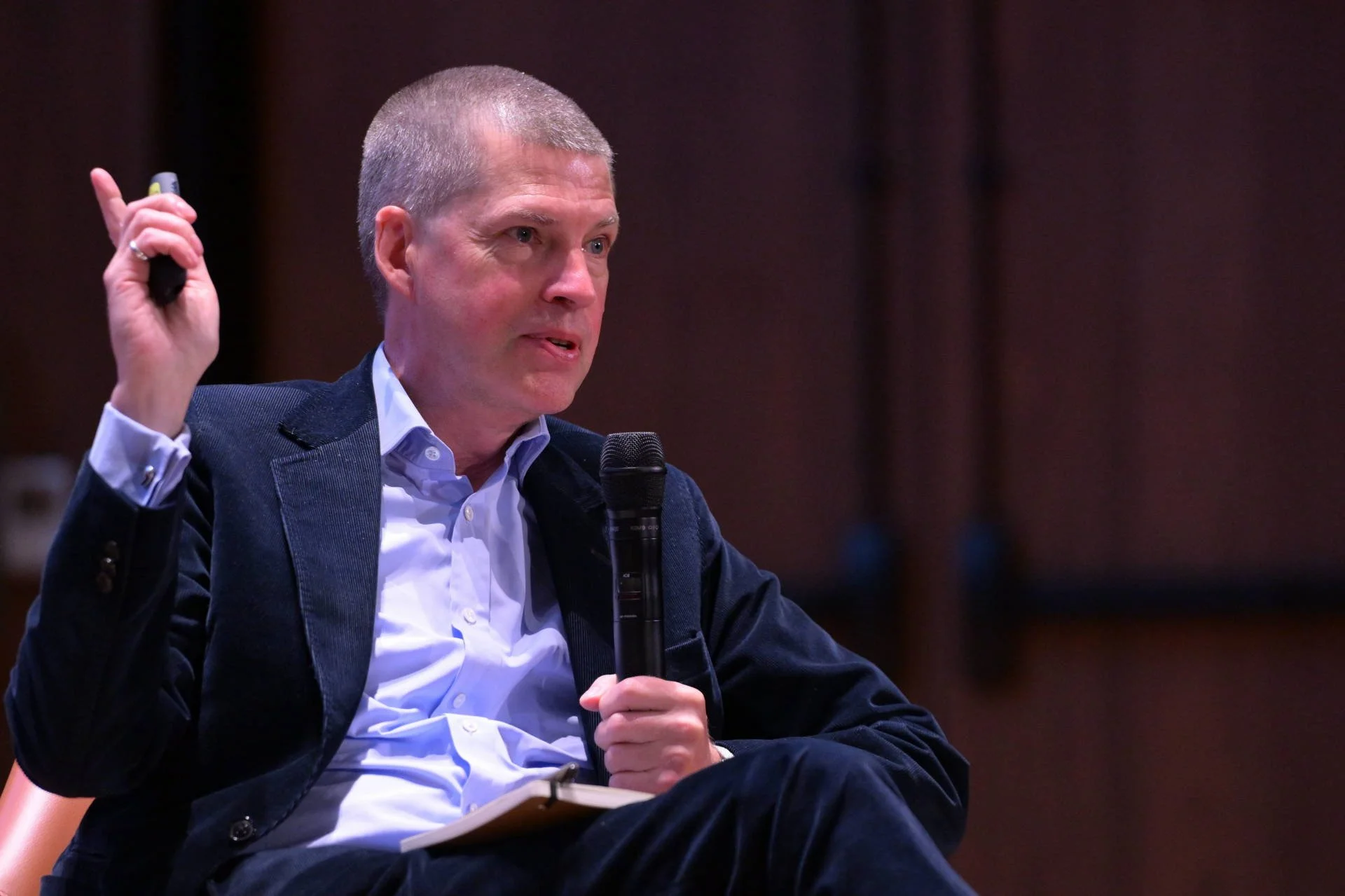
Jeffrey Murray: You talk a lot in your book, Constructing Health, about enriching environments and their health benefits. You talk about people, place, and relationships and use words like generous, authentic, hopeful, vital, natural. Can we have as powerful and effective relationships with places as with people?
Tye Farrow: Yes. The key point is realizing that our mind forms relationships with things. It's been very well studied in aesthetics, art, and psychology- such as Eric Kindel’s book “The Age of Insight”. We form emotional relationships with objects, like a sculpture and painting, as well as the building that we inhabit.
In my book, I've focused on the positive – emotional relationships we form with buildings, and to describe it I have used a model from psychology called a circumplex - which represents diagrammatically, using a layered circle, all feeling states - called affect. There is a vertical axis which represents arousal, from very sleepy to excited. The horizontal axis represents valance, feeling depressed to happy. But all sides of the emotional spectrum in buildings are important, from unsettling to exhilarating, depending on the circumstances. Usually, buildings stimulate the positive side of the emotional spectrum. Occasionally it is important to stimulate the unsettling side of the emotional spectrum in a building’s design. One of the most powerful buildings I've ever experienced is Libeskind's Holocaust Museum in Berlin, which does not feel positive at all. Why? Because it pushes you on your back foot to sense immense pain, suffering, and hopelessness. It’s so totally unsettling whereby you are both physically and psychologically put off balance because the floor is sloped and the walls are off plumb. It's either very cold or hot because large portions of the museum are open to the elements. T It is extraordinary architecture, whereby we experience - are moved to experience - specific human emotions. Yet when this vocabulary is used in a science museum, art gallery or housing project, the results are very unsatisfying - they are very unsettling - for the users, which to my mind is unnecessarily.
Let’s look at the more positive side of the emotional spectrum. For example, generosity and dignity, what might it mean or look like in architecture? We know what it looks like in person-to-person relationships. You can think of someone that has mentored you in your career. You didn't ask for help, but it was just given unconditionally. That’s generosity.
What does it look like in a building? Say we are in a rainy climate, maybe it's a canopy that keeps the rain off. If it's snowy environment, maybe it's an arcade or a colonnade that you can walk under to stay dry. If it's hot and sunny place, maybe it would be a double lined row of trees and a bench that you could sit in the shade to catch your breath. That is generosity.
Similarly, I think dignity is an important design element. It ties back to the concepts of ‘affordances’ – what a space or element naturally lets you do through its design - and also the concept of ‘signifiers’ – a hint the design solution gives you on how to use it - meaning if you come to a stair that has generous treads and risers - it's lovely and easy to walk up or down. That's a generous way of getting me from here to there. But if I'm in a wheelchair, not so much. Or if I'm a very young child or very old, maybe not so much either – that’s not expressing dignity to the user. Meaning how can the places we occupy encourage us, help us, to feel and be our best versions of ourselves. There's lots of layers around dignity and the built environment.
I believe the two lenses of generosity and dignity are fundamental in architecture. We know a lot of buildings that make your experience much more effortless. Some of the affordances are ‘literal’ like the previous example, while some are ‘metaphorical’ – such as a cathedral that lifts my eyes – and spirit. It isn’t literally lifting me, but psychologically it does.
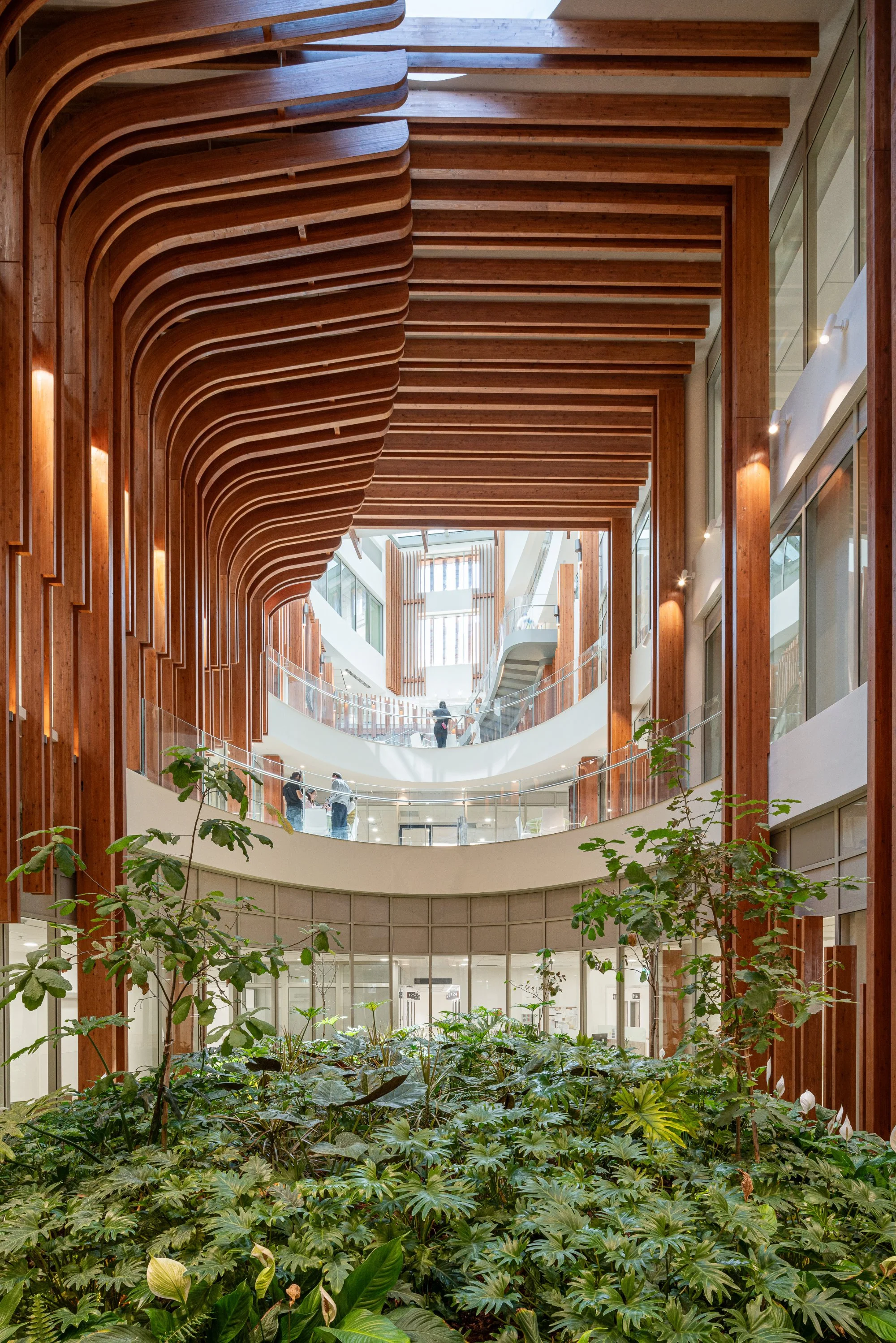
SZMC Helmsley Cancer Centre, Jerusalem, Israel, Farrow Partners and Rubinstein Ofer by Harel Gilboa
Some of the other emotional relationships we form with buildings that I believe are important are related to ‘variety’, ‘vitality’, and ‘authenticity’. For example, we know people that are authentic and some that aren't. If you look at architecture, it is the same. An example, if you look at Oscar Niemeyer's modernism in Brasilia, of which I was just there giving a talk and touring his buildings, all his buildings are very authentic to place and time. All the buildings are 60 years old and yet they look very fresh, but they also look like they've been there forever. So that idea of authenticity is real and rooted in its place, time and culture.
The next emotional relationship that we can represent in architecture is that of being natural. An architecture that is intuitive, flowing and fulfilling. There's lots of discussion these days around the concepts of biophilia, mid-range fractal patterns, natural light, and for me, importantly the near infrared light spectrum - because it nourishes our mitochondria, which is very important in every cell – all our physical bodily elements. On the other hand, things like these mid-range complex fractal patterns are very important because they feed our psychological bodily elements -our mind.
Taking that further, the feel of natural materials, the smell of natural scents, natural sounds, natural light, natural forms and rhythms, are important because they are about enhancing our ability to sense our surroundings through a multi-sensory way – through all our senses. But in our time of Instagram, TikTok, etc. – we focus a lot on the visual scene. Think of this in our design practices. When we design buildings, we make computer renderings to see what it looks like. We do material boards to see what it feels like – the difference between holding a wood, leather or steel door handle for example - one takes temperature away from you and the other gives it. It’s the importance of touch in experiencing our surroundings.
But do we make sound boards in architectural practice? No, we don't. We focus on noise, but we don't focus on sound. What about scent, like the smell of cedar? I believe we need to expand our design palette to use it to stimulate all of our senses.
Sander Schuur: That’s an interesting point.
Farrow: There is also evidence that we have different reactions to the materials we walk on, related to the sound they make - such as a wood floor and the sound it makes. That specific sound frequency affects your theta and beta waves; beta being the positive ones from the sound of walking on wood, specifically your theta waves that are linked to deep relaxation and intuition
These sounds then increase your positive serotonin levels, lower your stress, and cortisol levels. The scent of wood does the same thing. Specific types of wood are even better as they have both physiological and psychological positive bodily reactions.
Again, when we design buildings, we deal with visuals a lot and touch a little bit. We deal with noise, but we don't deal with sound. We deal with removing odors, but we don't deal with scent. And here's one that you're going to have to try on your next building: taste. For example, pleasant sights, sounds, and smells in a building can recruit brain regions that normally help construct flavor – our taste buds - especially the insula and orbitofrontal cortex, through learned multisensory associations. This means non-gustatory sensory input - can bias taste related circuits - and influence how tastes are anticipated or experienced, rather than there being a simple one-way pathway from each sense into a separate, isolated “taste area.” Meaning your surroundings can enhance our taste buds - we know that when we go into a great restaurant with lovely, views, smells and sounds – the food seems to taste better.
There are a few more senses that we usually don't focus on. One is kinesthetic, our perception of our bodies in space; are bodies and perception are designed to perceive through movement. The other is our vestibular system, which regulates balance and spatial orientation. Our perception is very different from experiencing, say a courtyard from the ground level looking up, compared to being on an upper balcony looking down.
“We deal with visuals a lot and touch a little bit. We deal with noise, but we don't deal with sound. We deal with removing odors, but we don't deal with scent. And here's one that you're going to have to try on your next building: taste.”
Then there is the emotional relationships of silence, stillness, intimacy and solidity. We can picture these in our person-to-person relationships. In space, they are relationships that communicate, for example hope. I would say again, Niemeyer's work feels very hopeful.
All these relationships are tie back to an important concept that isn't well known: salutogenesis, from the roots of salus, meaning health and genesis meaning origins, or the opposite pathogenesis, meaning the causes or origins of disease. Meaning that architecture can be health-giving - a non-invasive therapeutic treatment.
Murray: I like what you're saying about trying to integrate the aesthetic experiences that architects value so much with physiological outcomes - that mind body connection. And that you are collecting physiological evidence that says when our mind is engaged through design, we impact our physiological and mind health.
Farrow: Yes, and we can now measure all of these bodily changes related to our surroundings with wearable technologies. You can measure your stress or eustress levels - cortisol level and your serotonin levels. Heart rate variability is very important, not just heart rate. Your heart rate goes up if you're excited or stressed. Heart rate variability - when it's beating faster but slightly irregular - is the positive indicator of a regenerating body in relationship to your surroundings. Measuring your skin conductance, and muscle tension are also good indicators of how our bodies are responding to your environment.
These inexpensive wearable technologies can be used to measure these things; what's happening to your body in space. For example, we can use it to measure and understand how to enhance student learning – studies have shown at significant rates - based on specific classroom qualities, like good daylight and the use of natural materials such as wood. This has been well documented.
In healing environments, there are many well studied examples of better patient outcomes as a result of good environmental design characteristics. There's a frequently referenced study that found if hospital patients look out a window at nature, like trees, as opposed to a brick wall, then their recovery time is shorter, they use less drugs, and they need less follow-ups visits. Staff attraction and retention in these types of enriched healing environments are also shown to be enhanced because of environmental conditions.
This ties back to the importance of how our environments can be accelerants for our mind health – this being increasing seen to be very important. At the recent G7 summit in Alberta, the leaders identified brain health as the top foundational driver for human resiliency and innovation. Yet we're putting people in office or school environments that are the opposite of enriching places for brain health. Similarly, a 2025 report from the McKinsey Health Institute highlights the potential for brain health investment to boost global GDP by up to 12% - that is massive. This is linked to improved workforce performance, productivity, and innovation – and the same report mentions enriched environments as a key way to boost brain health. This came up at the Davos Economic Summit in 2025 as well. Meaning, we can use environmental enrichment to enhance mind health - creating the conditions where we can thrive and flourish, not simply produce.
This also relates to how the public is embracing the whole wellness-related industry and the massive shift in consumer spending towards wellbeing, which was somewhere around $6.5 trillion dollars in 2023. It's been increasing by 18% year over year for the last five years. It's the fastest moving, most dynamic market. And architecture and design have a central role to play – as we spend more time in doors than most whales spend underwater. We are focused on eating very nutritious meals and healthy foods - but we don’t view our environment as nourishments that feed all of our senses - but they do in the same way.
In the building space, the idea of wellness and enriched environments is moving into not just luxury markets, but also into affordable housing, schools, institutions, and hospital design. We are shifting our attention from not just solely the green building movement and environmental health but now shifting our attention to the importance of mind-health which results from our surroundings.
We are seeing signs of this in our professional bodies. The International Union of Architects declared 2022 the Year of Design for Health. And last summer the American Institute of Architects passed a resolution to fully adopted putting health and well-being into their code of ethics, awards judging processes, education, and being a key focus of research in architecture. This isn't just about stopping bad things from happening like ensuring you have enough exit stairs and no off gassing – a basic level of ‘standard of care’; it’s about shifting to use the surroundings to enhance human performance.
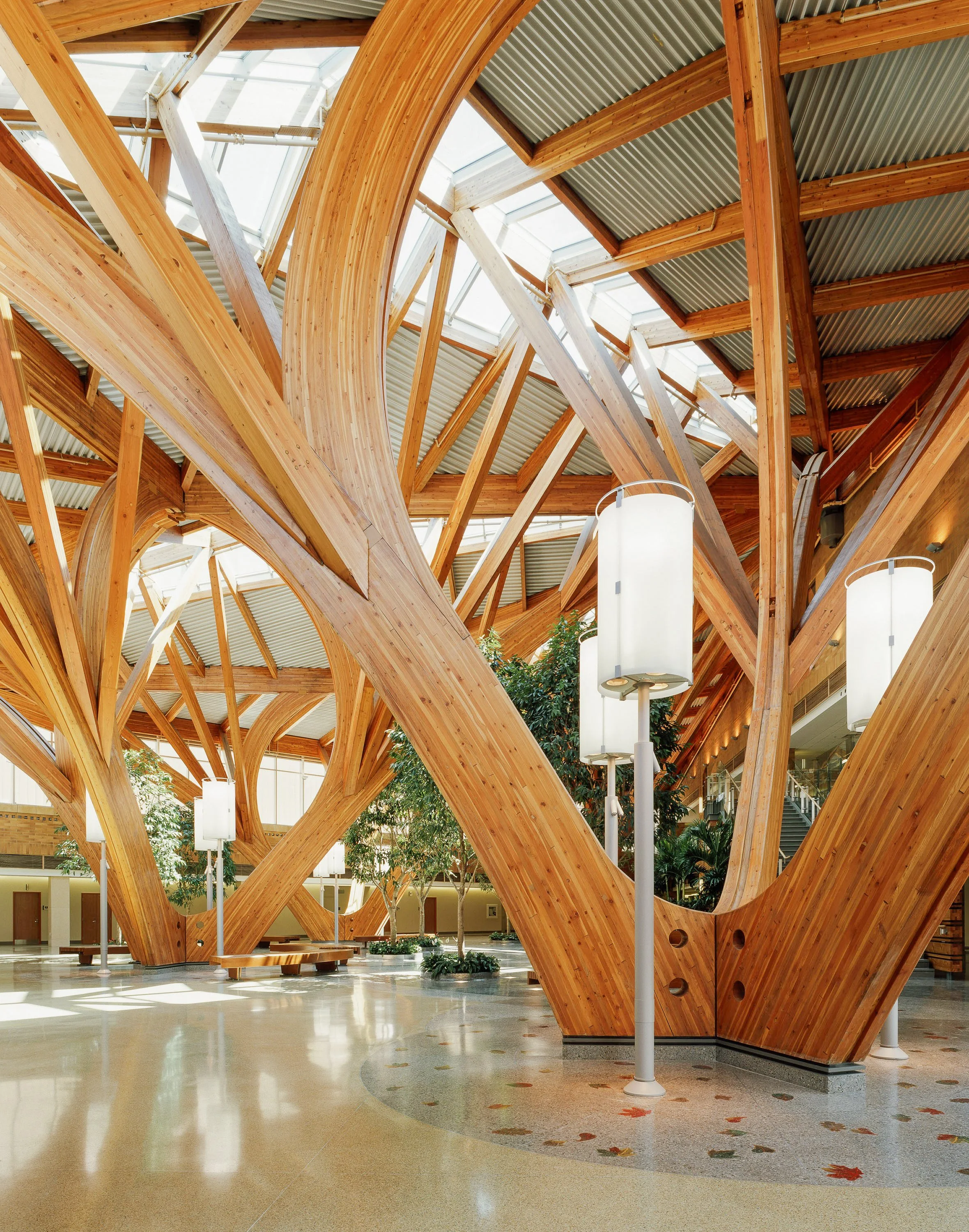
Credit Valley Hospital, Mississauga, Canada, Farrow Partners
by Peter Sellar
Murray: It's been a long time coming. About 8-10 years ago I made that one of my go-to phrases: well-being is the new sustainability. One of the things we struggle with, particularly in the US, are the financial people at hospitals, universities, and research institutes. They are going to question: is this for real? What's the ROI on all this? I'm sure you get that resistance too. How do you address that?
Farrow: Everybody asks that same question: this must cost more – how much? How did we get to the stage where the assumption is that a decent healthy building is going to cost more? It doesn't. We have no more money than anybody else does on any other project we design for our clients; but it is about what our priorities are.
An example that I often use is that for every nominal dollar we spend on the capital cost of a building, we spend five dollars on the operating cost of the building over its lifetime, meaning we should focus on the envelope and the systems of the building due to the impacts of design decisions on long term building operating costs. Yet what do we spend on staff within the building over that same period. Compared to the one dollar on capital and the five dollars on system operating costs - we spend two hundred dollars on staff costs - meaning that if a few of the pennies we spend on capital costs impact on human performance, it is far more impactful on the ‘health of the business’ than the costs of the buildings operating systems.
Here are a few other examples. We use a lot of wood - mass timber construction - in our buildings. Everybody says, well, that must be expensive. No. If I put up a wood column and a beam, then I don't have to finish it. All the aesthetics are already done. Compare that to what we usually do, where we put up say a steel structure and then we must add a dropped drywall ceiling and then maybe I put some aesthetic materials on it. All those things cost money - and also time - during construction.
Wood also has been shown to lower your heart rate, increase social interaction and empathy - all these things have been measured. It's also easier and faster to drill and hang mechanical ducts in wood construction, along with the lighting and everything else. That's all been quantified, again reducing the length of construction. Enhancing total value
That is why we see a lot of people now building offices from mass timber. They may cost the same as a traditional building, or maybe slightly more. However, if you include the cost of the whole construction process, it's faster to complete as mentioned previously. Importantly, on the value side, building owners have found they can charge higher rents - four and a half to seven and a half percent more tat a typical T-Bar ceiling office space - because when people walk in, they say, wow, this feels a lot healthier.
Murray: Right!
Farrow: The important point is setting our priorities. We all have a lot of stuff on our shopping list that we’d like to buy, but we can't afford it all. So, we prioritize what's important. We’ve all seen buildings that have all this stuff that's added on that have zero impact in the bigger picture of things. That’s not about prioritizing what is important.
And around the thought of creating health-giving buildings, the only way that you can have a healthful building, I believe, is to have a healthful design process, and that must be done through a co-creative process. It must have many diverse voices around the table.
““The only way that you can have a healthful building is to have a healthful design process, and that has to be through a co-creative process.” ”
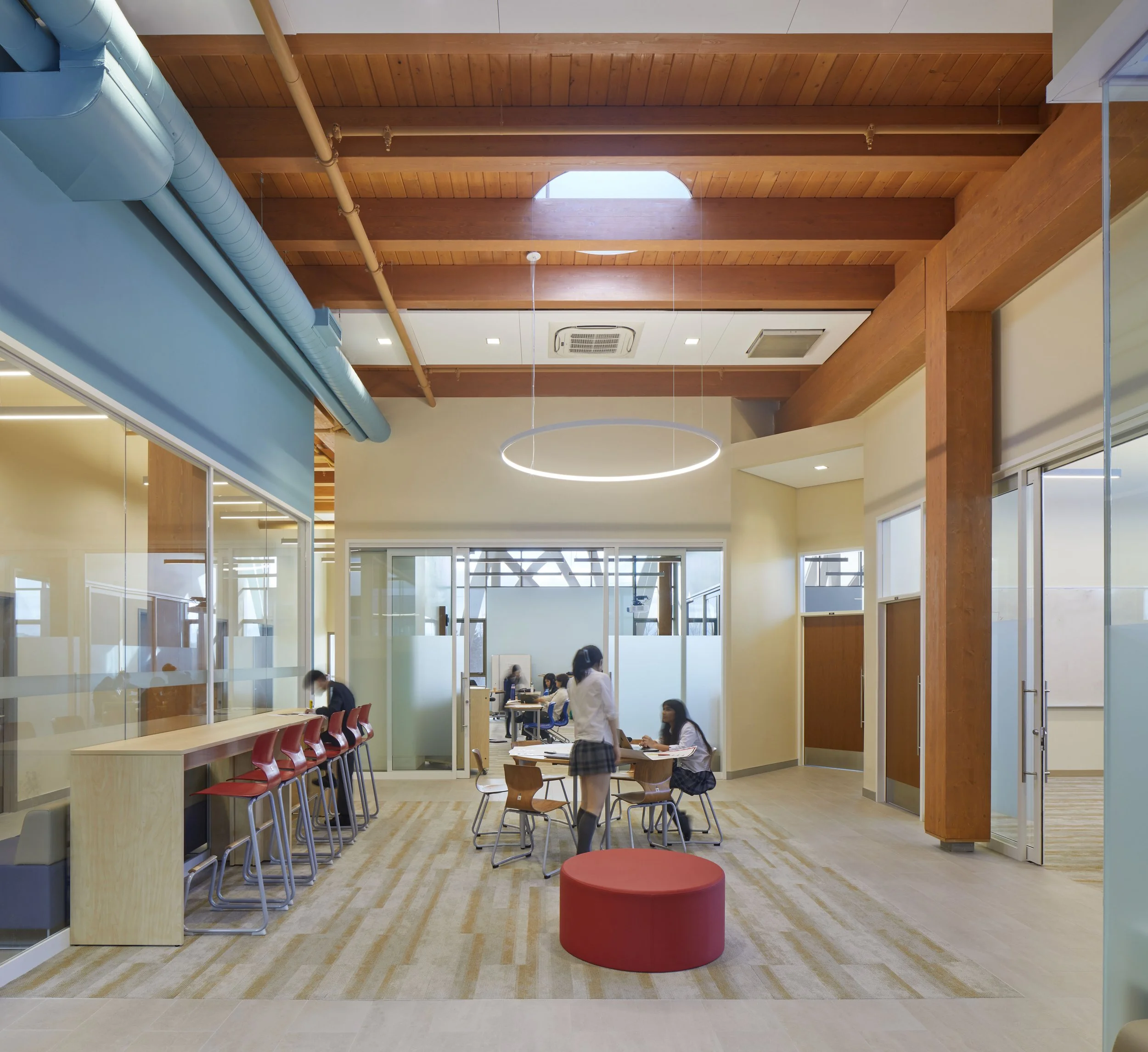
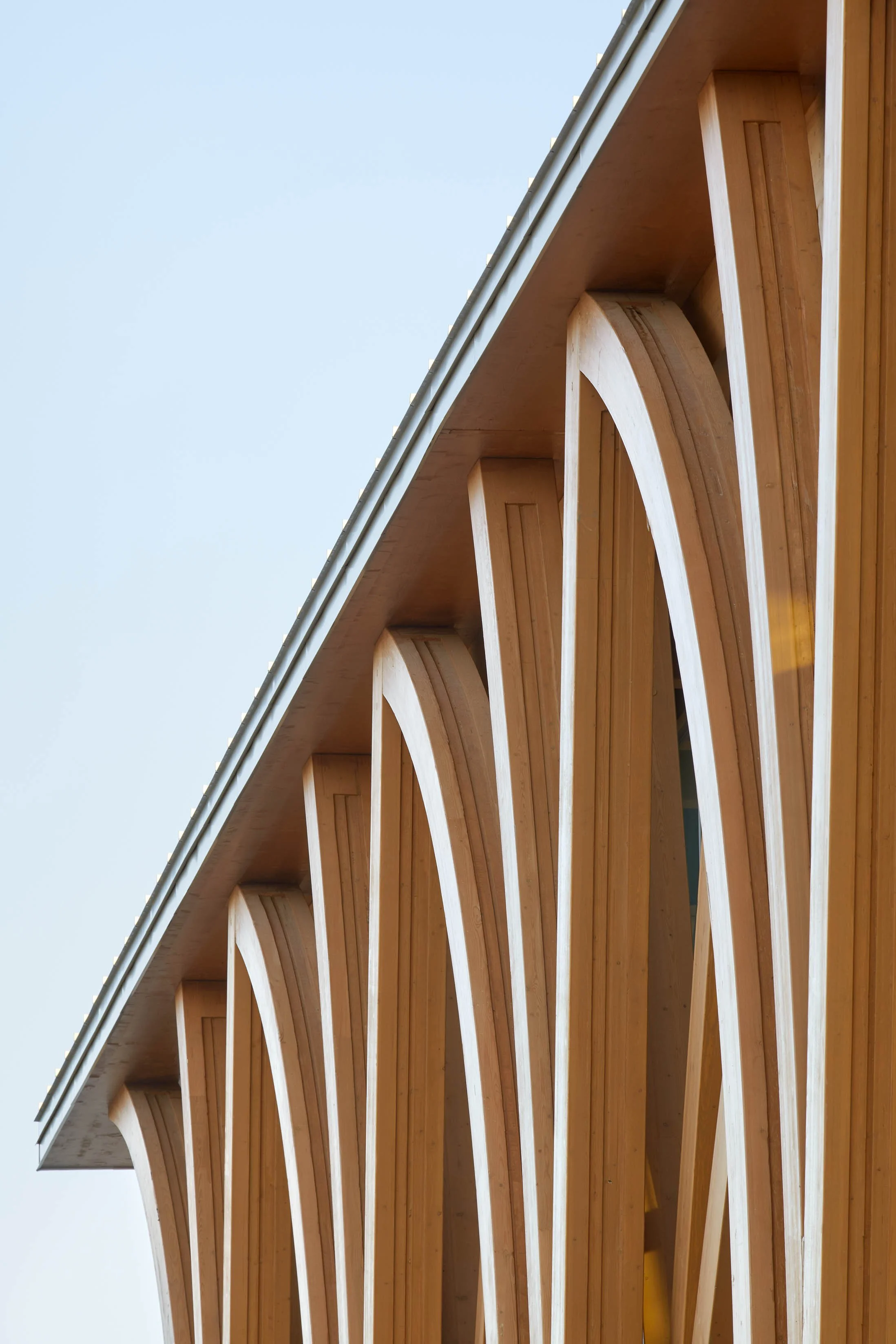
Lauremont Elgin Mills Campus, Richmond Hil, Canada, Farrow Partners
by Tom Arban
For example, we never go in with a design. We start off with finding ‘common ground’ and understanding what's really important. What will advance the organization’s missions and priorities? And then we move into a ‘critical eye’ discussion, where we show examples of different buildings. We ask, what do you see? What is it communicating? Is this important?
Then we move into large physical model of the site and explore, for example, where should the front door be? Where should the elements be that take advantage of the views? How should the program flow? And we develop as many options as people can think of and then we narrow it down - better or worse, better or worse - tied back to what are the strategic priorities for success we collectively established at the outset of the process.
And we have found that this type of process is faster than the usual process of presenting designs, then defending them against criticism, because we never go backwards, and because we have already prioritized what's important up front.
Murray: So that means you need mastery over the cost of things so that when some contractor comes in and says, well that's different, it must be more expensive, you'll say, wait a minute, you don't have this, you don't have that, you don't have this. What if we do that? You must be conversing and build those arguments to push against status quo thinking.
Farrow: You’re absolutely right. We encounter status quo thinking and assumptions that it’s going to cost more, as opposed to really looking at both the capital costs and the impact on enhancing measurable human performance.
Murray: I think what's critical for our mission is showing that what's good for wealthy people is also good for poor people. We must get past the thinking that places with one little window and drywall and no enriching environments are somehow OK for people because that's all they deserve. It's not enough to just say, well it's going to be safe and not toxic. So, the focus is it’s not going to make you sick? That’s kind of a pathogenic mindset, right?
Farrow: Yes. And ‘do no harm’ is a mindset that goes back to the rationalist thinking of the French philosopher Rene Descartes in the mid 1700’s, where he believed the mind and body were separate which we now know is not the case. What we need to do is create the conditions in which people can flourish, regardless of how much money you have.
Back to the idea of dignity as a driver for placemaking. What worries me is a lot of affordable housing that's being built right now looks like a 1950s motel. If you're a little kid trying to find the conditions in which you can thrive and flourish - and everybody's pointing and saying, there's the kid that lives in that poor place - you're already on your back foot. That’s not right, and it’s firmly in the realm of the architect to overcome this and create dignity.
“What worries me is a lot of affordable housing that's being built right now looks like a 1950s motel. If you're a kid trying to find the conditions in which you can thrive and flourish - and everybody's pointing and saying, there's the kid that lives in that poor place - you're already on your back foot.”
There's a firm in Denver, Shopworks. They are doing housing for vulnerable people, people who have had a really hard life. They're doing some of the most interesting work I've seen and doing it on a tiny budget. It's all about dignity. They have a PhD on staff and they're quantifying their work. In fact, they're taking hair samples pre and post occupancy to look at the composition of the cells and what it's doing in in these different environments. It's extraordinary work, and they've got little money but big aspirations. What are our priorities as people in a society? In their recent book, Designing for Dignity, they write “it is time to reframe the narrative to center on health and wholeness, to focus on flourishing and thriving, and to prioritize and stipulate a standard of dignity in all environments. As such, Dignified Design is not reserved for "them over there"- it's about health and hope for all of us.” I think that is so well said.
Schuur: I agree. We would like the public to understand more about how design choices make a difference in people’s lives, so they can then demand better design. Do you think people now understand that the built environment affects them?
Farrow: My book was designed to communicate these issues in a very accessible way, and to try and be a resource for students and professionals in architecture and the cognitive sciences. Also, it was designed as a large coffee table format book with lots of images so that it would be attractive to the public. Because once you see something, you can't unsee it, and next you ask for it. That’s what I attempted to do with my book for the public’s perception and understanding of healthful places, and what I believe the profession needs to help the public see.
One of the most exciting things for me was to see how the book has been received globally as well as in Canada -a book that is on the intersection of neuroscience and the built environment -reasonably heady stuff. However, there is a very large bookstore in Canada, with stores from coast to coast, and my book was the number one choice for chief book buyer for the fall and winter buying season for that retailer. When you walked into the bookstore it was displayed right up front. What's exciting is it is beginning to infuse this type of thinking to everybody, and so they demand more. It's sold1,500 copies globally for something on neuroscience And space making. I did a recent talk in Brazil that had 1,100 people in attendance. It appears these themes are resonating deeply with the public
I think this is because, post-COVID, people have begun to sense how some environments make us feel good and some do not. It's like the struggle to get people back to the office. Once you've worked from home and discovered home is so magical and you don't have to commute, and you have all this environmental enrichment at home – who wants to travel to sit in a cubicle that's mind numbing? The contrast is vivid and can’t be unfelt.
Schuur: I very much agree.
Murray: The dignity piece is really important. Speaking to designers, you have this theory of positive ambiguity in the book. Can you talk a little bit about that. What do you mean by positive ambiguity? Are you trying to give designers a set of tools or ways of thinking about how to create these healthful conditions?
Farrow: Our mind uses 20% of our body’s energy - a huge amount compared to any other organ – even though your brain is only 2% of the bodies entire weight. Your mind has been designed through evolution to be very, very, efficient. It likes to see something and sum it up very quickly. Meaning that if you see a straight corridor, you know exactly where you're going. Bam, it's over. But sometimes we see or engage with something that really stimulates and engages our mind. Think of, for example, the Rubin’s vase, where you look at a back profile of what looks like a vase on a white background. When you look closer you see the profile of two faces looking at each other. That is an example of positive ambiguity.
But there are places or things that stimulate and engage our minds, like painting, that really engage us because it ignites this idea of positive ambiguity. In the built environment, an example, is a street that has a gentle curve to it, compared to a grid iron city pattern. The curved street encourages your mind to want to discover what's around the bend, and your mind anticipates getting there and something that then will be revealed to you.
Positive ambiguity has also been shown to occur in what are known as mid-range complex fractal patterns that have a certain density that really stimulate the mind. Professor Richard Taylor has studied it as it relates to natural patterns in forests as well as Jackson Pollock drip paintings and to explain why we are so attracted to them and why people throw tens of millions of dollars at Pollack’s paintings. The reason, he believes, is they've got perfect mid-range complex fractal patterns -positive ambiguity - which stimulate the human mind perfectly through the density of and rhythm of the paint. If we go back to some examples of corporate modernism, we can understand why people might feel it is boring, as in some examples there isn’t that mid-range complexity that so engages the mind.
Schuur: Yes.
Farrow: Let’s go back to the example of Niemeier’s work, and he's got these beautiful curves in his buildings paired with these taunt lines. The curves are played against the straight lines within the designs-form shapes and rhythms. If you look at our own work, you'll see that we intentionally mix shapes and forms, curve shapes and triangular shapes, for example. Our eyes want to follow the curve around. With triangular or star shapes, our eye stops on the points. We see this mixing of shapes in nature, whereby they stimulate the mind because your eye is doing different things along the way. I’m simplifying it, but that’s basically the concept.
Murray: Complexity and contradiction.
Farrow: Absolutely. Venturi. It's the same thinking.
Murray: I go back to Alto. I remember in college I picked up Alto's article on humanizing architecture from 1940. And he said human psychology is so complex we don't really understand it, but we need to if we're going to do better. He talks about how he designed the rooms at the Paimio Sanatorium with that kind of a human-focused perspective. In my mind, complex geometries play that same game as the curve coming off the straight datum.
Farrow: Absolutely - those really sensuous lines against those really tailored pieces.
In my book I reference Aalto and how he embraced positive ambiguity and the integration of apparent opposites, suggesting that meaningful architecture arises from a “simultaneous solution of opposites” that is resolved in the mind of the viewer during spatial experience. The book quotes Aalto around blurring the boundary between reason and intuition, emphasizing that intuition “can sometimes be extremely rational,” and uses his thinking to support the argument that generous, enriched environments engage both cognitive and emotional processes in nuanced, non-literal ways – both/and.
Another architect who is much revered in the neuroscience and architecture intersection is Richard Neutra - his Lovell House, the Health House, and his philosophy. His book Survival through Design.
Murray: Really great book. Glad to see your passion for this, which both Sander and I share. It’s great for us to hear how you've taken fairly complex ideas and integrated them into the accessible tools in the book.
Farrow: I'm starting a doctorate in public health and researching the determinants of health. We know that environmental determinants show that if you have polluted water, soil or air, you're going to have bad health outcomes. Similarly, we know that societal determinants of health show that bad societal conditions lead to bad health outcomes. And economic determinants of health relate to policy outcomes that can negatively impact health and wellbeing.
All of these are well studied and touch a little bit on the built environment, but for the most part, they're focused on the pathogenic side of the equation - stopping bad things from happening.
As we now live in the Anthropocene epoch, the period when mankind is the dominant force on all aspects of our environment, I'm creating a model called the Architectural Determinants of Health through a salutogenic lens. Its goal is to show how these various theories are tied together. In parallel to this I have been developing the concept of salutodemiology - the study and shift from mapping risk and disease patterns (epidemiology) to mapping resources, positive functioning and health patterns at population scale.
What this will lead to are specific patterns of salutogenic placemaking. And I'm trying to develop this model linking architecture and health as tools to give to the architects to communicate these messages, which I think are crucial for our path forward, as there is no such thing as neutral space, that doesn’t enhance or hinder our health and wellbeing.
Murray: Fantastic. It's exciting to connect with people of a like mind and who are trying to make these ideas accessible. Thanks for your generosity.
Farrow: I look forward to sharing again.
This interview has been edited for clarity and length.