
Rethinking the Architect:
Filippo Lodi on multidisciplinary approaches to shaping how we live
At UNS (formerly UNStudio), Filippo Lodi leads a multidisciplinary studio exploring how architecture intersects with health, economics, and human behavior. In this wide-ranging conversation, he discusses why architects must evolve — and how design can shape a better society.
This interview with Filippo Lodi, Director at UNS, delves into the evolving role of architects in tackling complex societal challenges. Speaking with Sander Schuur and Catey Gans Kyrö, Lodi reflects on the future of the profession — from rethinking architectural education and embracing multidisciplinarity to addressing macroeconomic forces and public health through design.
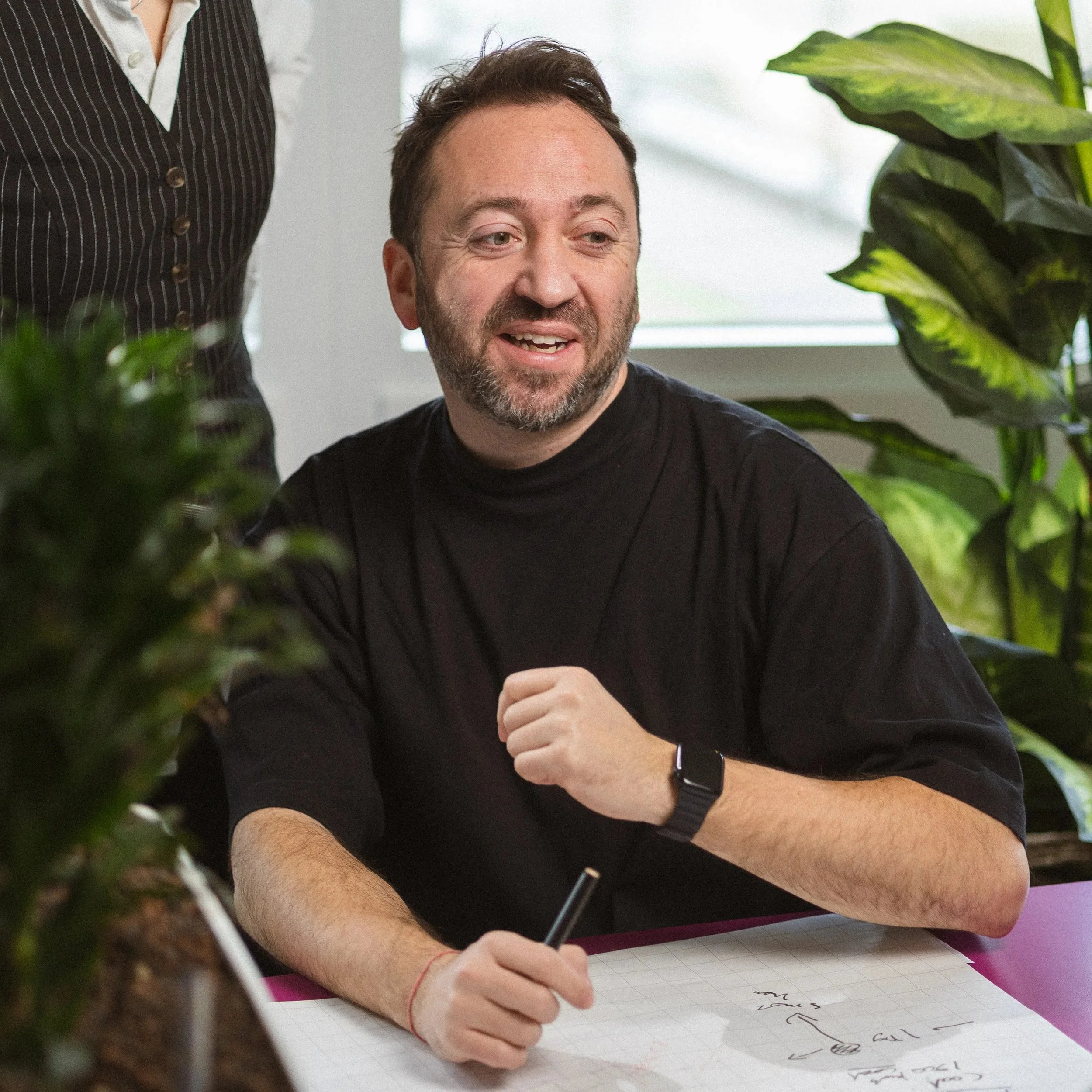
Sander Schuur: Could you tell us about the change from UNStudio to UNS as a restart addressing your goal to look beyond architecture to formulate UNS for the future?
Filippo Lodi: There has been a lot of interest from our side to re-evaluate the role of the architect over time. What will be our role - especially with the advent of super technologies that accelerate development? It challenges the very essence of the discipline.
The training of architects is historically very specialized and that comes from two routes. One is the very technical - all the technical universities that have populated the field of knowledge; and the other is the arts, where you have a more artistic sense, more aesthetic.
We need to evolve. Rather than focusing only on one of these two routes, the evolution of the discipline should support more multidisciplinary thinking as this is needed to solve complex problems. Then you need to address the needs of others, like policymakers, by speaking about topics like longevity, construction, the economy, budget, spatial solutions, psychology, and sociology components.
This is where the education systems fail because the teaching in architectural schools is not contemporary. It's so outdated even in the best schools that I'm shocked, especially the US schools. They offer such a lousy set of programs that we don't have a match between education and the real world.
There are so many realms [of knowledge] that we need to include to reposition the architect.
Much of the research our studio has been engaged in over the past year has focused on health. What we observe across many healthcare systems is a strong tendency toward reactive models of care — addressing issues once they manifest rather than anticipating them. From a design and spatial perspective, this raises an important question: how can we contribute to a shift toward prevention, supporting long-term wellbeing rather than only intervention?
This is the fundamental question guiding our work. We approach it through multiple avenues — from participation in collaborative research projects to applied studies that translate insights into design intelligence. Within the studio, we’ve built on a substantial body of research around the world’s blue zones, including work developed by Ben van Berkel at Harvard GSD. Alongside this, we have explored themes such as designing for happiness and are currently initiating new research focused on parental wellbeing.
“We've worked a project on designing for happiness, and are starting one now about parental well-being. We examine societal questions and how they intersect with the built environment.”
We examine societal questions and how they intersect with the built environment. To make this research tangible and actionable, it often needs to be supported by data and measurable indicators. This is an area where architects traditionally collaborate with specialists — including large engineering practices with deep expertise in quantitative analysis. Our particular strength lies elsewhere: in synthesizing and curating diverse forms of knowledge, and in translating complex insights into spatial strategies. Architects are especially adept at designing for human and social needs that resist easy quantification.
Schuur: Let’s further discuss your point on re-evaluating the role of the architect. In Sweden, I saw a trend in the last 10 years where the reason to build for developers is often purely economic and the challenge you get from the client is often to save money in whatever corner you can find. Do you see a similar trend in in the Netherlands or internationally?
Lodi: The economic dimension is central to our work. This is why we have established a dedicated group of economic specialists within the studio — a Center of Excellence with backgrounds in real estate and finance — who work alongside developers, cities, and public institutions.
Economics forms a critical backbone of any project, and engaging with it fluently is essential within the design process. When designers are able to actively participate in these conversations, economic considerations become a shared framework rather than an external constraint, allowing design expertise to remain both relevant and influential.
In our work, we often encounter macroeconomic and policy decisions that have significant and sometimes unintended impacts on quality of life. In the Netherlands, for example, longstanding housing policies such as the mortgage-interest deduction and other incentives for homeownership were originally intended to support buyers and economic stability. However, these incentives — combined with a limited housing supply — have contributed to persistent affordability challenges and rising property values, which in turn put pressure on both ownership and rental markets.
In Barcelona and Catalonia more broadly, legislative interventions under Spain’s Housing Law have introduced mechanisms to limit rent increases in areas officially classified as high-pressure housing markets. Early data shows that these measures have correlated with stabilizing rents in some segments, but they also interact with broader supply challenges and can influence investor behaviour and rental stock availability.
These kinds of macroeconomic and regulatory tools have direct ramifications for how cities function and for people’s everyday lives. This is precisely why designers and planners should be part of these conversations: not to enact policy, but to ensure that systemic decisions are translated into spatial, social, and economic strategies that account for lived experience.
For many in real estate, this way of thinking is still unfamiliar. We believe design can help by reimagining the real estate product itself — creating new propositions that better respond to societal needs. That requires a multidisciplinary perspective, where economic logic is integrated with spatial and social intelligence, rather than treated in isolation.
“For many in real estate, this way of thinking is still unfamiliar.”
Catey Gans Kyrö: Education plays a large role in shaping the architects and stakeholders of the future. What do you see as academia's role in shaping the future of architecture and the built environment?
Lodi: There is a strong role for academia to impact the future of the built environment, but we are neglecting it. We focus now on the things that you can see, the people that you meet within a certain context. Instead, we should require an approach with more multidisciplinary exposure. Institutions can do that because programs such as a masters degrees need to be certified by a body. These bodies should be taking more ownership of the impact that they can have because it will automatically transform the built environment. I would love to have a conversation at that level because that's where the fundamental problems begin.
Throughout my educational journey, I’ve been drawn to problems that don’t fit neatly within a single discipline. I started in engineering, only to see that architects were addressing the questions I cared about. Then in architecture, I realized that economic frameworks often shaped the solutions, so I explored economics. Today, my focus is increasingly on psychology and human health, which I see as central to the challenges we face. We all have our own growth path.
Schuur: To include that broad knowledge would be a major challenge for any university. I would like to revisit the discussion of the role of the architect. What are the big steps forward and the big challenges on the way? Where do you want to see architects be in society in 10 years?
Lodi: As a discipline, architects need to broaden and deepen their knowledge. Expanding what we understand allows us to take true ownership of the built environment and its impact on society. Many factors influence quality of life and societal wellbeing that often go unnoticed in design. Greater awareness of these forces would enable architects to create places that are not only functional and beautiful, but also genuinely supportive of human health and social life.
“…architects need to broaden and deepen their knowledge. Expanding what we understand allows us to take true ownership of the built environment and its impact on society.”
For example, we collaborated with a Swedish research institute [IVL Svenska Miljöinstitutet] on an EU-funded research project developing a biocomposite material. The institute has extensive expertise in volatile organic compounds (VOCs), based on decades of research into paints used in submarines, where soldiers spend long periods in enclosed spaces. The paints need to be free of VOCs to ensure breathable air and long-term health. Yet when we examine air-quality data in our cities — for instance, in the Netherlands — the results are alarming. In some cases, exposure is worse than smoking. Knowledge like this deserves far greater attention in design and urban planning.
Repositioning the role of the architect means going beyond what is traditionally taught in schools — developing a broader perspective and continuously expanding our knowledge. When asked about my job, I rarely describe myself simply as an architect, because that feels reductive. Architecture has traditionally been associated with drawings and buildings, but the scope of what we do today is far wider. Redefining the role of the architect is essential if we want to address the complexity of the environments we shape.
Kyrö: I want to know more about the qualities of integrating people into projects and, as an architect, being the person to connect the different disciplines. How do you find the format and space for a multidisciplinary approach in projects?
Lodi: We engage at multiple levels. For example, our studio contributed to national urban development discussions in the Netherlands that informed the publication What We Want Has Never Been Done, a book on integrated spatial approaches produced in collaboration with De Bouwagenda and partners including UNStudio. In that context, we contributed as external expert voices helping to shape thinking about integrated planning. Another level of our engagement is acting as a connector between different stakeholders, such as municipalities and developers.
Some municipalities have particularly advanced frameworks. Amsterdam, for instance, created the role of Chief Technology Officer — held by Ger Baron — to integrate technology and data into city strategy and development, helping bridge innovation and spatial planning. Cities everywhere are evolving, but their approaches vary widely.
A onesizefitsall strategy is not possible, given the diversity of governance models and local priorities. Navigating this complexity requires teams with both local experience and broader perspectives. Whether working in the Middle East, South America, or North America, we try to include people who understand the context deeply while also bringing a neutral, multidisciplinary lens that helps generate appropriate solutions.
For example, in Austin, Texas, the city’s identity as a technology and innovation hub influences how public and private actors approach data, smart city tools, and strategic planning — shaping the conversation around metrics and performance alongside design. In Dubai, strategic agendas such as the Dubai Real Estate Sector Strategy 2033 prioritise growth, investment, and sustainable development alongside innovation, making economic and investment lenses central to decisionmaking. When we’re working with different stakeholders, we tailor our language and tools accordingly.
The vocabulary changes too: topics like circular economy and sustainability are strongly emphasised in contexts such as Denmark, where collaborative urban innovation hubs and sustainability networks are active, whereas in Spain, the discourse often centres on urban regeneration and housing affordability, reflecting how policy language and priorities differ by context.
Kyrö: Even sustainability is a word that's used in so many different ways and contexts. It would be helpful to have a database of these different terms and how they connect, where they are used and what they mean where. Have you found anything like that?
Lodi: Sustainability is one of the most complex terms, and achieving a shared understanding is challenging. At our studio, we define it across multiple dimensions: social, economic, and technical sustainability. In some contexts, sustainability is embedded in the brand of a region, developer, or firm. In others, it may not even be explicitly mentioned — yet it is still an underlying requirement of the project. Meeting these expectations often involves formal certification, such as LEED, but it also requires thinking beyond the label to ensure real, measurable quality and impact.
“We need to reposition ourselves as equals in the conversation and be proficient in talking about real estate values and metrics that define the built environment.”
Schuur: How does your research connect to everyday projects? How do you communicate findings back to your colleagues?
Lodi: At UNS, we have knowledge-sharing practices at multiple scales. These include searchable data repositories and internally developed AI tools created by our R&I team to manage data securely, alongside human exchange through events and courses to continuously learn and share insights.
The studio operates in a truly multidisciplinary way. At first, this can be surprising for some, as colleagues encounter people from very different backgrounds working in diverse ways. Collaboration requires effort, negotiation, and sometimes even rethinking how people physically share space to encourage cross-disciplinary interaction.
Over the past five years, UNS as a whole has grown in scale and scope, expanding multidisciplinary collaboration across the organization. Scaling to this size requires new strategies to ensure knowledge flows freely and silos are avoided. Informal interactions that work in small groups become impractical at larger scale, so we now organize smaller, project-based teams within the broader organization to maintain the close collaboration necessary for effective multidisciplinary work.
Kyrö:The PGH Platform brings different actors together to have multidisciplinary conversations. How can we recruit people to participate, to prioritize coming?
Lodi: When engaging across disciplines, focus on the essence of the problem in discussions, marketing, and proposals. For example, if you are working with the real estate sector, frame the conversation around core challenges such as: How can we address the housing shortage? To tackle fundamental issues effectively, present them from a pragmatic, solution-oriented perspective.
It is equally important to understand the people you interact with. Who are they, and what do they need? Every interaction — whether an event, a meeting, or a presentation — should have a clear purpose and mutual benefit. The world is highly pragmatic, and people respond best when they see tangible value in the conversation.
This interview has been edited for clarity and length.